Books
Production-Grade Enterprise Architecture
A practitioner series for architects, CISOs and engineering leaders in regulated organizations. Each volume takes one class of AI system from demonstration to production: the invariants that must hold, the controls that prove them, and the operating model that keeps them true on day two.
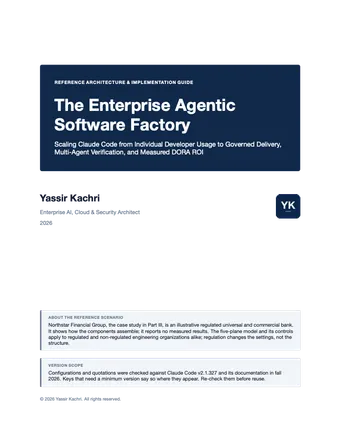
The Enterprise Agentic Software Factory
Scaling Claude Code from Individual Developer Usage to Governed Delivery, Multi-Agent Verification, and Measured DORA ROI
231 pages · Kindle eBook · 2026
A reference architecture and implementation guide for running AI coding agents as a governed software factory. Part I is an executive brief with the decisions, the indicators to measure and a 90-day plan. Part II builds the five planes of the factory, then gives change management, governance and day-2 operation a chapter each. Part III assembles the components for an illustrative regulated bank, reproduces every configuration in full, and closes on one consolidated checklist.
Core arguments
- Amdahl's Law caps delivery speed at the stages that wait on people: intent, review and rework.
- Ungoverned agents run up technical, intent and cognitive debt at machine speed.
- Level 3 conditional autonomy is the standard for regulated production: human judgment moves to a Spec Gate and a Merge Gate.
- Five planes: intent, context and workbench, verification, headless CI/CD sandbox, gateway and telemetry.
- Four independent verification stations: no session certifies its own change.
- Spend is governed by agent cost per merged change; decision rights follow reversibility.
- A 90-day rollout with three exit gates, release rings and graduated kill switches.
Contents
- Part I — Executive Brief
- 1. Diagnosis: the delivery bottleneck and the triple debt
- 2. Intent: durable specifications and the Spec Gate
- 3. Context and workbench: settings, hooks and worktrees
- 4. Verification: four independent stations
- 5. Headless CI/CD and the zero-trust sandbox
- 6. FinOps, telemetry and DORA
- 7. Change management
- 8. Governance and decision rights
- 9. Day-2 run
- Part III — 10. Case study · Appendix A (configurations) · Appendix B (checklist)
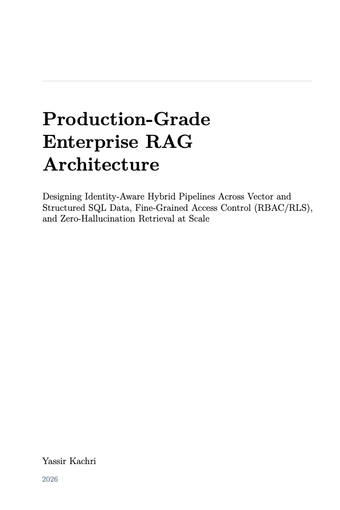
Production-Grade Enterprise RAG Architecture
Designing Identity-Aware Hybrid Pipelines Across Vector and Structured SQL Data, Fine-Grained Access Control (RBAC/RLS), and Zero-Hallucination Retrieval at Scale
152 pages · Paperback (6×9) · Kindle · 2026
Naive RAG fails in regulated firms on identity, arithmetic and evidence, not on model quality. Volume 1 follows a fictional regulated firm through eleven incidents and builds the six-plane architecture that prevents each one: authorization as an input to retrieval, governed SQL for figures, nothing readable at rest, admission on provenance, and verified citations.
Core arguments
- One identity token governs both the document path and the SQL path: relationship-based scope inside the vector search, row-level security inside the database.
- Dual-Path Hybrid RAG: arithmetic goes to certified metrics and reconciles to the ledger before it reaches an answer.
- Stored vectors can be inverted back to text, so the storage plane holds nothing readable.
- Content is admitted on provenance, not on a blocklist.
- Every sentence cited, every answer recorded, every release gated on proofs.
Contents
- 1. Threat model
- 2. Parsing and change data capture
- 3. Chunking
- 4. Access control
- 5. Vector hardening
- 6. Poisoning immunity
- 7. Hybrid search
- 8. Dual-path SQL
- 9. Citations and audit
- 10. Release gates
- 11. Production operations and SRE
- Appendix A — Brownfield playbook
Next in the series
- Volume 2 Forthcoming
Production-Grade Enterprise Agentic AI Architecture
Agents that act on enterprise systems: identity, tool authorization, MCP server governance, evaluation and operations for agentic AI in regulated production.
- Volume 3+ Planned
Further volumes
Additional volumes in the series are planned across AI, cybersecurity and governance. Titles will be announced when the manuscripts are under way.
Be told when each volume is released
Optional. One short email per release: store links for the completed books and news on Volume 2.