Agentic AI Security
Agent-to-Agent Trust: What A2A v1.0 Signed Agent Cards Prove, and What They Do Not
A2A v1.0 specifies how an agent signs the card that describes it. The signature proves the card is intact and comes from the key holder. Trusting the agent behind it still takes a registry, per-request authorization and a revocation path.
On 12 March 2026, the Agent2Agent project released version 1.0.0 of its protocol. A2A defines how one agent discovers another, learns what it can do, and sends it work. The discovery step rests on a single document, the Agent Card, which the specification defines as “a JSON metadata document published by an A2A Server, describing its identity, capabilities, skills, service endpoint, and authentication requirements.”
When an orchestrating agent decides to delegate a task, the Agent Card is what it reads. That makes the card a security boundary in its own right, and the v1.0 specification defines its integrity mechanism in detail (the signatures field itself dates from version 0.3.0): Agent Cards “MAY be digitally signed using JSON Web Signature (JWS).” Signing is a meaningful protection, and it is also easy to read more into it than it provides.
What a signed card proves
The specification states the purpose of signing plainly: signatures “allow clients to verify that an Agent Card has not been tampered with and originates from the claimed provider.” The mechanism is precise. Before signing, “the Agent Card content MUST be canonicalized using the JSON Canonicalization Scheme (JCS) as defined in RFC 8785,” with the signatures field itself excluded from the signed content. Each signature carries a protected header naming the algorithm and the key identifier, and a client verifying the card retrieves the key, canonicalizes the card the same way and checks the signature. The specification adds that “Clients SHOULD verify at least one signature before trusting an Agent Card,” and that “Expired or revoked keys MUST NOT be used for verification.”
A verified signature therefore establishes two things: the card has not changed since it was signed, and whoever holds the signing key produced it. An agent that fetches a card through a proxy, a cache or a registry can now tell whether anything in between altered it.
What it does not prove
| Question a delegating agent needs answered | Does a valid signature answer it? | Control that does |
|---|---|---|
| Was this card altered after it was signed? | Yes | JWS over the canonicalized card |
| Does the signing key belong to a provider I trust? | No | A trusted key store or registry of approved providers and their keys |
| Are the skills and capabilities on the card accurate? | No | Onboarding review of the agent before it enters the registry, and monitoring of what it actually does |
| Is this particular request authorized? | No | Authentication with a declared scheme on every request, and authorization by the receiving agent |
| Is the agent still trustworthy today? | No; verification fails only once the key is revoked or expired | Key rotation and revocation, and removal from the registry |
Source: A2A specification v1.0.0 (12 March 2026), sections 2.2, 3.1.11, 7 and 8.4; OWASP Top 10 for Agentic Applications for 2026 (December 2025), ASI04 and ASI07. Controls are the author's.
The second row is where most designs will need explicit work. The signature proves possession of a key. Whether that key belongs to an organization the enterprise has decided to trust is a separate decision. The specification notes that clients “MAY maintain a trusted key store for known agent providers” and lists registries among the ways to discover agents, but it leaves both optional and leaves the trust decision to the deployer. Without such a store, a malicious agent can sign its own card with its own key, and the signature will verify.
The third row matters because everything on a card is written by its publisher. A card can advertise skills its agent does not have, or describe itself in terms designed to win delegation. The OWASP Top 10 for Agentic Applications, published in December 2025, lists this pattern among its supply-chain scenarios as “Agent-in-the-Middle via Agent Cards,” where a compromised or rogue peer advertises exaggerated capabilities. Signing does not prevent it, because a rogue publisher can sign an exaggerated card as easily as an honest one.
The protocol also anticipates that the public card is not the whole picture. An authenticated client can retrieve an extended card, and the specification notes that the operation “MAY return different details based on client authentication level, including additional skills, capabilities, or configuration not available in the public Agent Card.” Trust decisions should be made on the card the client will actually rely on.
Every request is authenticated, and authorization is the receiving agent’s decision
A2A keeps credentials out of its message semantics. “Identity information is handled at the protocol layer, not within A2A semantics,” the specification says, and a client “includes these credentials in protocol-appropriate headers or metadata for every A2A request.” The card declares which schemes the server accepts, and the server “MUST authenticate every incoming request based on the provided credentials and its declared authentication requirements.” Version 1.0 also tightened the OAuth options, removing the implicit and password flows and adding device code and PKCE, according to its release notes.
That design places a clear obligation on the receiving agent: it must authenticate every request and decide, for each one, whether the caller may ask for this work. The OWASP entry on insecure inter-agent communication describes what happens without that discipline: weak controls for “authentication, integrity, confidentiality, or authorization let attackers intercept, manipulate, spoof, or block messages.”
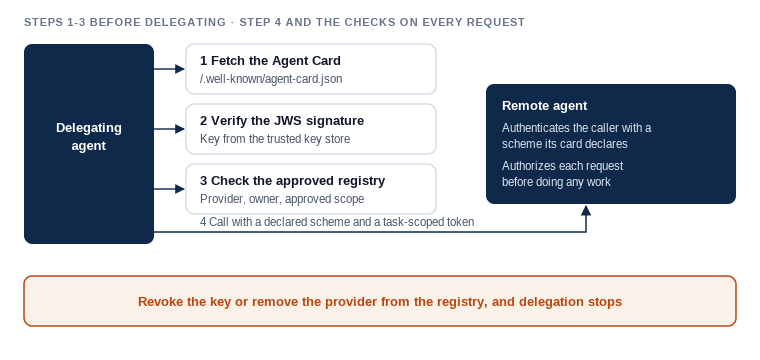
Source: Author's diagram, based on the A2A specification v1.0.0 discovery, signing and authentication sections.
Four controls for an enterprise adopting A2A
Run a registry of approved agents and their keys. Every agent an internal orchestrator may delegate to should be listed with its owner, its signing keys and the scope of work it is approved for. Verification against that registry, and against keys from it, turns a signature into a trust decision.
Review an agent before it enters the registry. The card describes what an agent claims to do. An onboarding review establishes what it actually does, with which tools and data, and who answers for it.
Authorize per request, with narrow credentials. Delegation should carry a token scoped to the task, issued for the receiving agent, and checked by that agent on every call, whatever the card says.
Plan revocation before the first delegation. The specification forbids verification with revoked keys. That rule only protects an organization that can revoke a key, remove an agent from the registry and see delegation stop, and it is worth testing that path before an incident requires it.
Signed Agent Cards close one gap that unsigned discovery left open. The remaining gaps are the ones an enterprise already knows how to close for services and APIs, and the same disciplines apply when the caller and the callee are both agents.