Agentic AI Security
Cascading Failures in Agent Systems: Retry Budgets, Breakers and Blast Radius
When one agent's fault spreads to others, the damage comes from propagation. How load cascades and semantic cascades differ, what resilience engineering already offers, and where agents need controls of their own.
The OWASP Top 10 for Agentic Applications for 2026, published in December 2025, states that “Agentic cascading failures occur when a single fault (hallucination, malicious input, corrupted tool, or poisoned memory) propagates across autonomous agents, compounding into system-wide harm.” Its entry, ASI08, is deliberately narrow. It “focuses on the propagation and amplification of faults rather than their origin,” and applies “only when that defect spreads across agents, sessions, or workflows, causing measurable fan-out or systemic impact beyond the original breach.”
That scoping is useful for architects, because it separates two questions that are often merged: what went wrong first, and why it spread. The second question has a long history in distributed systems, and much of the answer carries over to agents, with one category of fault that it does not cover.
Two kinds of cascade
The evidence available in September 2026 falls into two groups. Load cascades are well documented in production distributed systems, including at an AI provider, and agent-specific load problems have been reported during development. Semantic cascades, where a wrong but well-formed output is accepted and acted on by the next agent, have been demonstrated repeatedly in research. I have not found a public post-mortem that describes one between agents in production.
| Load cascade | Semantic cascade | |
|---|---|---|
| What spreads | Requests, retries, spawned tasks, cost | A wrong answer, an injected instruction, a fabricated result |
| Typical symptom | “rapid fan-out,” “oscillating retries or feedback loops between agents,” “downstream queue storms” (OWASP) | Downstream agents act confidently on bad input; nothing fails visibly |
| Production and development evidence | An infrastructure cascade at an AI provider (OpenAI); early agents “spawning 50 subagents for simple queries” during development (Anthropic) | Not found in public post-mortems |
| Research evidence | Extensive, from distributed systems | Self-replicating prompts across agents; multi-agent systems made to execute attacker code in “58-90%” of trials |
| Controls | Established: retry budgets, deadlines, load shedding, bulkheads, breakers | Early: verification between agents, provenance, human checkpoints |
Source: OWASP Top 10 for Agentic Applications for 2026, ASI08 (December 2025); Google SRE book, ch. 22; OpenAI incident write-up (December 2024); Anthropic Engineering (13 June 2025); arXiv 2410.07283, 2503.12188, 2408.00989. Classification is the author's.
Load cascades: resilience engineering already applies
The Google SRE book defines a cascading failure as “a failure that grows over time as a result of positive feedback,” and names its most common cause: “overload.” AI providers have met the classic form: OpenAI’s December 2024 outage began with “a new telemetry service deployment that unintentionally overwhelmed the Kubernetes control plane, causing cascading failures across critical systems.”
Agents add their own sources of load, so far reported mostly from development. Anthropic’s account of building its multi-agent research system describes how “Early agents made errors like spawning 50 subagents for simple queries, scouring the web endlessly for nonexistent sources, and distracting each other with excessive updates,” and notes that multi-agent systems “use about 15× more tokens than chats.” In the same post: “Agents are stateful and errors compound.”
The retry arithmetic from the SRE book shows why layered agents are exposed. If “the backend, frontend, and JavaScript layers all issue 3 retries (4 attempts), then a single user action may create 64 attempts (4^3) on the database.” An agent stack has the same shape when a planner retries a subagent, the subagent retries a tool call, and the tool’s client library retries the API. As an illustration, with the same three retries at each of those three layers, one planner request against a failing API becomes 64 attempts on the system behind it.
Four controls from existing practice apply directly.
- Retry at one layer only. AWS’s guidance is that, “for low-cost control-plane and data-plane operations, our best practice is to retry at a single point in the stack,” and it warns that retrying at the top of the stack can waste work already done. For agents, I would let the tool gateway retry individual tool calls, have the planner retry only the failed subtask, and make every other layer fail fast.
- Budget retries and turns. The SRE book recommends a “server-wide retry budget,” and Anthropic’s guidance on building agents notes that “it’s also common to include stopping conditions (such as a maximum number of iterations) to maintain control.” A run should carry a budget for turns, spawned agents, tool calls and tokens, enforced outside the model.
- Propagate deadlines. “Rather than inventing a deadline when sending RPCs to backends, servers should employ deadline propagation,” in the SRE book’s words. A subagent should inherit the time its parent has left.
- Isolate with bulkheads. The Azure bulkhead pattern “stops a fault in one part of the system from cascading across the rest.” Separate pools of capacity and credentials per tenant, per workflow or per class of agent keep one runaway run from starving the others.
OWASP adds circuit breakers to the list: “blast-radius guardrails such as quotas, progress caps, circuit breakers between planner and executor.” The Azure pattern describes a breaker that “prevents an application from performing an operation that’s likely to fail,” with a half-open state that “helps prevent a recovering service from suddenly being flooded with requests.” AWS offers a counterpoint worth weighing: circuit breakers “introduce modal behavior into systems that can be difficult to test,” and AWS prefers “limiting retries locally using a token bucket.” My own approach departs slightly from OWASP’s placement: I would put breakers on calls to external tools and services, where the failure is outside the agent system, and use token buckets for retries inside it.
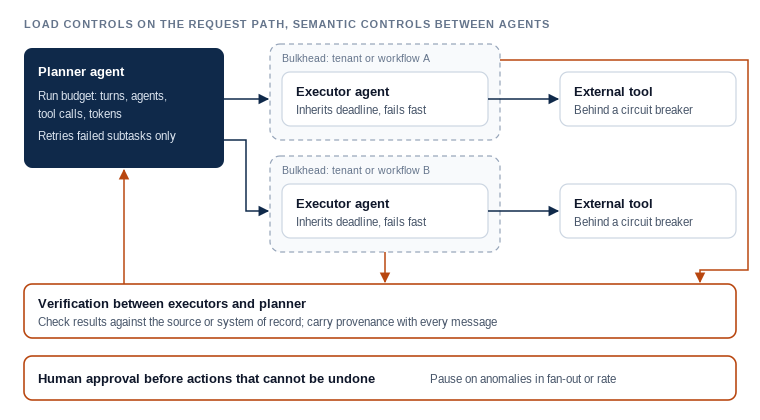
Source: Author's diagram, based on OWASP ASI08 mitigations, the Google SRE book, AWS Builders' Library and Azure Architecture Center patterns cited above.
Semantic cascades: the part agents add
The SRE chapter, the AWS library and the Azure patterns deal with load and with errors that can be counted. An agent that passes a fabricated result to another agent produces neither, and none of those patterns would detect it.
Research has shown how far such faults travel. The Prompt Infection paper describes “a novel attack where malicious prompts self-replicate across interconnected agents, behaving much like a computer virus,” and found that “multi-agent systems are highly susceptible, even when agents do not publicly share all communications.” A 2025 study of orchestrated systems found that web content could make the system “execute arbitrary malicious code in 58-90% of trials (depending on the orchestrator)” when its agents ran on GPT-4o, and that “these attacks succeed even if individual agents are not susceptible to direct or indirect prompt injection.” These are laboratory results, and they suggest that hardening each agent separately is not enough to make the system safe.
Research also points to controls that helped in these experiments, and OWASP adds one of its own.
- Verify between agents. A study of multi-agent collaboration with faulty agents found that adding an “Inspector, an additional agent to review and correct messages,” recovered “up to 96.4% errors made by faulty agents,” and that a hierarchical structure degraded least. A verification step can also be deterministic. In my view, checking that a cited source exists, that a number matches the system of record or that an output conforms to a schema catches many fabrications without another model.
- Carry provenance with every message. The Prompt Infection authors propose a defense they call LLM Tagging which, “when combined with existing safeguards, significantly mitigates infection spread.” More generally, I would attach the origin of content to every message between agents, so that an agent receiving text that started in a web page can treat it as untrusted, whichever agent relayed it.
- Stop before irreversible steps. OWASP’s mitigations for ASI08 call for “Checkpoints, governance agents, or human review for high risk before agent outputs are propagated downstream,” and for rate limiting that can “throttle or pause on anomalies.” For semantic faults, I would place a human approval before actions that cannot be undone, at the point where the fan-out begins.
Testing how far a fault travels
OWASP’s most demanding mitigation for ASI08 is “Digital twin replay and policy gating: Re-run the last week’s recorded agent actions in an isolated clone of the production environment.” It is costly to build, and it is the most complete way to see how a change in one agent’s behavior propagates before it reaches production.
A lighter version is within reach of most teams: record full traces of multi-agent runs, inject a faulty output at one agent in a test environment, and measure how many downstream agents act on it and how far the effect reaches. Research on tracing failures in multi-agent logs found that the best method identified the responsible agent with “53.5% accuracy” and the failing step with “only 14.2%.” Finding the origin after the fact is hard, so the controls above, and a test of how far a fault travels, are worth putting in place before the first incident.