Agentic Software Factory
What DORA 2025 Says About AI-Assisted Delivery, and What It Cannot Tell You
The 2025 DORA report finds AI now improves delivery throughput while still increasing instability, and names seven capabilities that amplify its benefits. How to read the findings, and how to test them on your own services.
In September 2025, Google Cloud published the DORA report on the state of AI-assisted software development, based on a survey of nearly 5,000 technology professionals. Its central finding is phrased carefully: “AI’s primary role in software development is that of an amplifier. It magnifies the strengths of high-performing organizations and the dysfunctions of struggling ones.”
For a leader deciding where to invest, that sentence is more useful than any headline percentage. It says the return on AI tools depends on the organization they land in. The report is also explicit about a trade-off: “AI adoption now improves software delivery throughput, a key shift from last year. However, it still increases delivery instability.”
The findings, and the limits of each
| Finding (verbatim) | What it supports | What it cannot tell you |
|---|---|---|
| “The majority of survey respondents (90%) use AI as part of their work” | AI use is now the norm in the surveyed population | How much of anyone’s work it covers, or how well |
| “a notable portion (30%) currently report little to no trust in the code generated by AI” | Review and verification stay necessary | Whether that distrust is well calibrated for a given codebase |
| “AI adoption now improves software delivery throughput… However, it still increases delivery instability.” | Faster delivery and more failures can arrive together | The size of either effect in a particular organization |
| “AI’s primary role in software development is that of an amplifier.” | Capabilities around the tools decide the return | Which capability matters most for a particular team |
Source: DORA, State of AI-assisted Software Development 2025 (Google Cloud, September 2025). Implications and limits are the author's.
The limits come from the method. A survey measures what respondents report, across many organizations at once. It can show that organizations with certain characteristics tend to report better outcomes; it cannot show that adopting a tool will produce those outcomes in any one of them. Self-reported speed in particular deserves caution: in METR’s 2025 randomized trial, experienced open-source developers took 19% longer with AI tools while believing they had been 20% faster. METR has since marked those results as out of date for current models, but the gap between felt and measured speed is a reason to test any survey finding against delivery data.
Seven capabilities amplify the benefit of AI
The report introduces what it calls its first DORA AI Capabilities Model. From an initial set of 15 candidate capabilities, drawn from 78 in-depth interviews, the opinions of subject-matter experts and previous DORA research, seven “showed substantial evidence of an interaction with AI use”: when teams paired them with AI adoption, “the difference AI made across important outcomes was amplified.” The seven are a clear and communicated AI stance, healthy data ecosystems, AI-accessible internal data, strong version control practices, working in small batches, a user-centric focus, and quality internal platforms.
Read as an architect, several of them describe systems that a platform or architecture team builds and runs.
- AI-accessible internal data and healthy data ecosystems describe governed retrieval: internal knowledge that tools can reach, with quality and access controls that hold when an assistant is the one reading it.
- Strong version control practices and working in small batches describe the delivery pipeline that receives AI-generated changes. Small, reviewable changes keep review effective as the volume of change rises.
- Quality internal platforms describes the shared layer where policy, credentials, guardrails and telemetry live, so that each team does not rebuild them.
- A clear and communicated AI stance and a user-centric focus are organizational, and they set the boundaries inside which the technical capabilities operate.
Source: Author's diagram. Capabilities from the DORA AI Capabilities Model (2025); metrics guidance from DORA's software delivery metrics guide.
Testing the findings on your own delivery
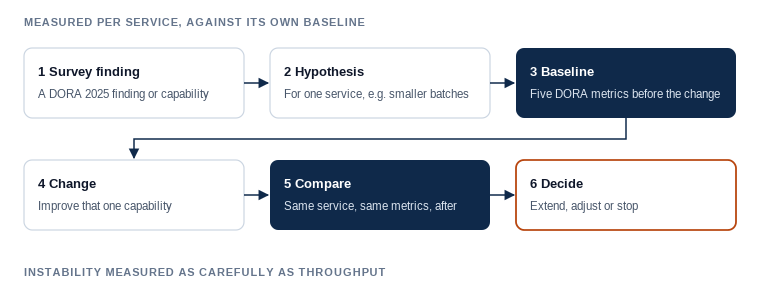
DORA’s own guidance on its metrics points the way. The five delivery metrics, including the deployment rework rate, “are meant to be applied at the application or service level,” and the goal is to improve a team’s performance over time, “not to compete against other teams or organizations.”
For an organization deciding how to invest in AI-assisted delivery, I would turn the report into three steps for a small number of services. First, turn one finding into a hypothesis for one service, choosing a capability the team already suspects is weak, for example batch size where changes are large. Second, build a baseline of the five metrics for that service before changing anything. Third, improve that one capability and compare the service with its own baseline afterwards, with instability measured as carefully as throughput, since the report’s own finding is that the two can move together. The comparison decides whether to extend the change, adjust it or stop.
The report draws on nearly 5,000 respondents and is a broad view of how AI is changing software delivery. It describes averages across those respondents, so the decision for any one organization rests on its own data.