AI Governance
From ISO/IEC 42001 and the NIST AI RMF to Controls an Engineer Can Test
AI governance frameworks describe what to govern and leave the tests to the organization. How to turn ISO/IEC 42001 and the NIST AI RMF into controls with an owner, a test and evidence an auditor can check.
Two documents are widely used as anchors for enterprise AI governance. ISO/IEC 42001, first published in December 2023, “specifies the requirements and provides guidance for establishing, implementing, maintaining and continually improving an AI (artificial intelligence) management system within the context of an organization.” The NIST AI Risk Management Framework, released in January 2023, organizes AI risk work into four functions and is “intended to be voluntary, rights-preserving, non-sector-specific, and use-case agnostic.”
Both are written for governance and risk functions. Neither tells an engineer what to build or how to show that it works, and this is where a governance program can stall: policies exist, risk registers exist, and nobody can point to the test that proves a given control is in force on a given system today. I close that gap by translating each requirement into a control an engineer can test.
What the two frameworks actually contain
ISO/IEC 42001 follows the harmonized structure shared by other ISO management system standards, which means “identical clause numbers, clause titles, text and common terms and core definitions.” Its requirements sit in clauses 4 to 10: Context of the organization, Leadership, Planning, Support, Operation, Performance evaluation, and Improvement. Four annexes follow. Annex A, which is normative, lists “Reference control objectives and controls”; Annex B gives implementation guidance for them; Annexes C and D are informative. The standard is certifiable: ISO/IEC 42006, published in July 2025, sets out additional requirements for the bodies that audit and certify against it.
The NIST AI RMF defines four functions, each broken down into categories and subcategories:
- GOVERN “cultivates and implements a culture of risk management,” and NIST describes it as “a cross-cutting function to inform and be infused throughout the other three functions.”
- MAP “establishes the context to frame risks related to an AI system.”
- MEASURE “employs quantitative, qualitative, or mixed-method tools, techniques, and methodologies to analyze, assess, benchmark, and monitor AI risk and related impacts.”
- MANAGE “entails allocating risk resources to mapped and measured risks on a regular basis and as defined by the GOVERN function.”
For generative AI, NIST added a companion profile in July 2024, NIST AI 600-1, which “defines risks that are novel to or exacerbated by the use of GAI.” It lists twelve, among them confabulation, data privacy, information security, and value chain and component integration.
A note on crosswalks: a mapping between the AI RMF and ISO/IEC 42001 is published on NIST’s AI Resource Center, but it was submitted by Microsoft against a draft of the standard, and the page states that inclusion “does not imply NIST endorsement.” I treat it as a useful starting point and check each mapping against the published standard.
A control is testable when it has four properties
A framework requirement becomes something an engineer can implement and an auditor can check once it is restated as a control with four properties:
- A named owner, accountable for the control on a defined set of systems.
- A test, automated where possible, that passes or fails.
- Evidence, produced by the test itself, stored where an auditor can retrieve it.
- A cadence, tied to change: the test runs when the system or its dependencies change, and at a fixed interval in between.
| NIST function | Related ISO/IEC 42001 clauses (by title) | Example control | Test | Evidence |
|---|---|---|---|---|
| GOVERN | Leadership; Support | Every AI system and AI tool in use is inventoried with an owner | Inventory compared with what is deployed and installed | Inventory diff report, per run |
| MAP | Context of the organization; Planning | Each agent context is reviewed for private data, untrusted content and outbound channels | Design-review checklist required before release | Signed review record linked to the release |
| MEASURE | Operation; Performance evaluation | Quality, groundedness and isolation tests run before every release | Evaluation suites in CI, with thresholds | Evaluation results stored with the release |
| MANAGE | Operation; Improvement | A compromised agent or tool can be disabled within an agreed time | Scheduled kill-switch drill | Drill log with time to effect |
Source: NIST AI RMF 1.0 (NIST AI 100-1, January 2023); ISO/IEC 42001:2023 clause titles. Example controls, tests and evidence are the author's.
The table illustrates the method; a complete control set would be larger. The examples come from patterns covered earlier in this series: the lethal trifecta review as a MAP control, and the AI audit trail as the evidence store behind several of them.
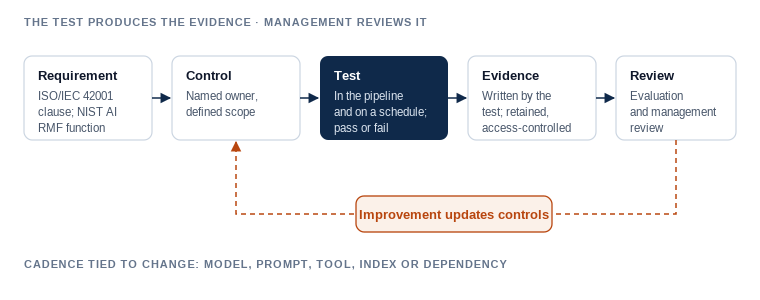
Source: Author's diagram. ISO/IEC 42001 clause titles; NIST AI RMF function names.
Three design choices make the evidence trustworthy
Generate evidence from the control itself. I treat evidence written by hand, after the fact, for an audit, as the weakest kind. A release gate that stores its evaluation results with the release, or a drill that writes its own log, produces evidence as a side effect of operating. Performance evaluation, clause 9 in ISO/IEC 42001, then becomes a review of records that already exist.
Tie the cadence to change as well as to the calendar. AI systems change when a model version, a prompt, a tool, a retrieval index or a dependency changes, so a control tested quarterly can be out of date the day after a release. Running the test in the delivery pipeline, and blocking the release when it fails, keeps the control and the system in step.
Keep the mapping in one place. The same control often satisfies several frameworks, and the European Union’s AI Act adds its own obligations on top. A single control catalogue, with each control mapped to the clauses and functions it supports, avoids maintaining one set of evidence per framework. Version that catalogue like code, so that a change to a control is reviewed and its history is visible.
Where to start
For an organization with a policy but few testable controls, I would start with the four in the exhibit: an inventory, a design-review record, release-time evaluations and a kill-switch drill. Each can produce evidence within weeks, and together they touch all four NIST functions. The rest of the control catalogue can grow from there, guided by the organization’s risk assessment and, where the goal is to be certified against the standard, by Annex A.