Agentic AI Security
Least Agency: Reading the OWASP Top 10 for Agentic Applications as an Architect
OWASP's first Top 10 for agentic applications can be read through one principle, Least Agency. How its ten risks reduce to four design decisions, and the controls that put each decision into configuration.
On 9 December 2025, the OWASP GenAI Security Project published its Top 10 for Agentic Applications for 2026. The ten risks are worth knowing, but I find the document’s most useful idea in a principle it introduces before the first entry: “We expand on the concepts of Least-Privilege and Excessive Agency by citing Least-Agency.” OWASP describes it as advice “to avoid unnecessary autonomy; deploying agentic behavior where it is not needed expands the attack surface without adding value.”
Least privilege limits what an identity may access. Least Agency limits how much an agent may decide and do on its own, which is the property that makes agents different from the applications security teams already know. Read through that lens, the ten entries reduce to four design decisions an architect has to make before any agent reaches production.
The ten risks reduce to four design decisions
| Decision | Entries | The question to answer in design review |
|---|---|---|
| What the agent may do | ASI02 Tool Misuse and Exploitation; ASI05 Unexpected Code Execution (RCE) | Which tools, with which scopes, rate limits and network destinations, and where does generated code run? |
| On whose authority | ASI03 Identity and Privilege Abuse; ASI07 Insecure Inter-Agent Communication | Which identity does each action carry, for how long, and how do agents authenticate one another? |
| What it trusts | ASI01 Agent Goal Hijack; ASI04 Agentic Supply Chain Vulnerabilities; ASI06 Memory & Context Poisoning | Which inputs, tools, models and stored context can change the agent’s behavior, and who vouches for them? |
| How it stops | ASI08 Cascading Failures; ASI09 Human-Agent Trust Exploitation; ASI10 Rogue Agents | What limits a fault’s spread, what does a human see before approving, and how is an agent switched off? |
Source: OWASP Top 10 for Agentic Applications for 2026 (OWASP GenAI Security Project, December 2025); grouping and questions are the author's.
The grouping is mine; OWASP presents the entries as a numbered list and maps each to its more detailed Agentic AI Threats and Mitigations taxonomy. I find the grouping useful because each decision has an owner. Tool scopes belong to the team that builds the agent, identity to the identity and access team, trust in third-party components to the supply-chain process, and stopping conditions to whoever runs the service in production.
Goal hijack is the entry every control has to assume
ASI01 states the premise the rest of the list depends on. Agents and the underlying model “cannot reliably distinguish instructions from related content,” so an attacker can steer an agent through “prompt-based manipulation, deceptive tool outputs, malicious artefacts, forged agent-to-agent messages, or poisoned external data.” OWASP distinguishes it from LLM01:2025, Prompt Injection, which “focuses on altering a single model response”; ASI01 covers the case where the manipulated input redirects a multi-step plan.
I therefore design on the assumption that some injected instruction will eventually be followed, and I place the controls that matter outside the model, where the instruction cannot reach them. If safety depended on the model recognizing every malicious sentence, one well-written email or document would be enough to defeat it.
Tool misuse is where Least Agency becomes configuration
ASI02 is the entry that turns the principle into something a platform team can deploy. Its first mitigation is titled “Least Agency and Least Privilege for Tools,” and it asks for per-tool profiles of “scopes, maximum rate, and egress allowlists,” expressed “as IAM or authorization policy stanzas attached to each tool, rather than relying on ad-hoc conventions.” The examples are concrete: read-only queries for databases, no send or delete rights for an email summarizer.
The other ASI02 mitigations describe, between them, a control point that sits between the model and its tools:
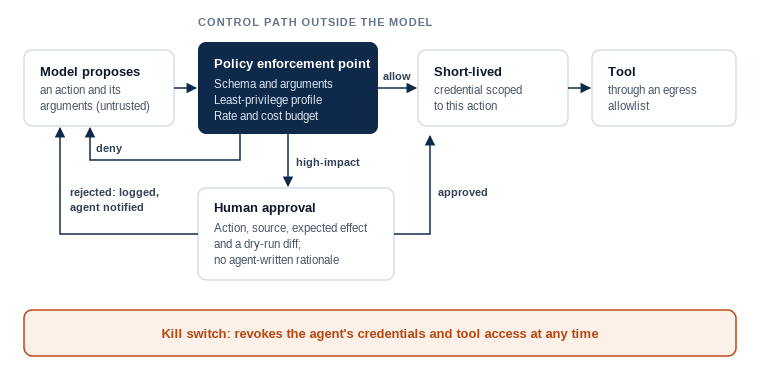
Source: Author's diagram, based on the ASI02, ASI09 and ASI10 mitigations in the OWASP Top 10 for Agentic Applications for 2026.
- Treat the plan as untrusted. The “Policy Enforcement Middleware (‘Intent Gate’)” mitigation asks to “Treat LLM or planner outputs as untrusted,” with a policy enforcement point that “validates intent and arguments, enforces schemas and rate limits, issues short-lived credentials, and revokes or audits on drift.”
- Approve the action itself. “Action-Level Authentication and Approval” requires human confirmation “for high-impact or destructive actions (delete, transfer, publish)” and a dry-run diff before approval.
- Bound the spend. “Adaptive Tool Budgeting” applies cost, rate or token ceilings “with automatic revocation or throttling when exceeded.”
- Make access expire. “Just-in-Time and Ephemeral Access” grants credentials that “expire immediately after use” and asks to “Bind keys to specific user sessions.”
None of these requires a particular product. They require that every tool call passes through one place the organization controls, which is the strongest argument I know for routing agent traffic through a gateway or an orchestration layer that the platform team owns, with no direct path from the model’s output to an API.
Approval screens are part of the attack surface
ASI09 deserves more attention than its position suggests. OWASP describes agents that build trust through “natural language fluency, emotional intelligence, and perceived expertise,” and humans who end up “approving actions without independent validation.” Two of its mitigations bear directly on review. One asks for a “plain-language risk summary (not model-generated rationales)” when users report suspicious behavior. Another, “Separate preview from effect,” blocks state-changing calls during preview and displays “a risk badge with source provenance and expected side effects.”
The design rule I draw from both applies to every approval screen. An approval request shows the action, its arguments, the source of the instruction and the expected side effects. It does not show the agent’s own explanation of why the action is a good idea, because that explanation is exactly what an attacker who has hijacked the goal will have written.
Stopping is a design requirement, specified before launch
ASI08 and ASI10 cover the failures that outlast a single request: a fault that “propagates across autonomous agents” and agents that “deviate from their intended function or authorized scope.” The ASI08 mitigations concentrate on limiting spread, with isolation between agents and “blast-radius guardrails such as quotas, progress caps, circuit breakers.” ASI10 adds “kill-switches and credential revocation to instantly disable rogue agents,” and ASI04 a “Supply chain kill switch” for tools, prompts or agent connections when a compromise is detected.
A kill switch earns trust only through rehearsal. I would ask for three things before launch: who can pull it, what exactly it revokes (credentials, tool access, the agent’s queue), and evidence from a drill that it works within the time the service’s risk owner accepts.
Five questions for a design review
The OWASP document offers far more mitigations than one review can cover. These are the questions I would start with:
- Where in this use case is autonomy actually needed, and what would a non-agentic design lose?
- For each tool, what is the least-privilege profile, and where is it enforced outside the model?
- Which identity does each action carry, and when does that credential expire?
- What does a human see before approving a high-impact action, and is any of it written by the agent?
- Who can stop the agent, what does stopping revoke, and when was that last tested?