Agentic AI Security
MCP 2026-07-28: Dynamic Client Registration Deprecated, Issuer Checks and a Stateless Core
The 2026-07-28 MCP specification deprecates Dynamic Client Registration, adds issuer validation against mix-up attacks and removes sessions. What changed in authorization since 2025-11-25, and what enterprise teams should update.
The Model Context Protocol published its 2026-07-28 specification on 28 July 2026, after a release candidate locked on 21 May. The announcement described it as “the next version of the MCP specification,” released “along with the SDKs that will allow you to start building clients and servers right away.” The headline changes are architectural: the changelog’s first entries remove sessions and the initialize handshake, making the protocol stateless.
For teams that run remote MCP servers or build clients for them, the authorization changes matter as much. The 2025-11-25 revision, which I covered in February, made Client ID Metadata Documents the recommended way for clients to register. The 2026-07-28 revision goes further on registration, and adds checks that close attacks the earlier text left to implementers.
What changed in authorization
| Area | 2025-11-25 | 2026-07-28 |
|---|---|---|
| Client ID Metadata Documents | SHOULD | SHOULD, unchanged |
| Dynamic Client Registration | MAY | MAY, and deprecated; clients MUST set application_type when they use it |
| Issuer identification (RFC 9207) | Not addressed | Clients MUST record the issuer, validate iss when present and reject its absence when advertised; authorization servers SHOULD send it |
| Client credentials and issuers | Not addressed | Pre-registered and dynamically registered credentials MUST be keyed by issuer and never reused with another authorization server |
| Step-up scopes | Server’s challenge should carry previously granted scopes | Client computes the union of previous and newly challenged scopes |
| Refresh tokens | Rotation required for public clients | Rotation kept; new section on confidentiality, grant_types and offline_access |
| Protected Resource Metadata, resource indicators, audience, no token passthrough | MUST | MUST, unchanged |
Source: MCP specification 2025-11-25 and 2026-07-28, authorization pages and changelog (modelcontextprotocol repository at its last commit before 29 August 2026). Comparison is the author's.
Dynamic Client Registration is deprecated. The changelog states the intent: “Deprecate the OAuth 2.0 Dynamic Client Registration Protocol (RFC7591) as a client registration mechanism in favor of Client ID Metadata Documents.” The normative text keeps it as a MAY, noting that it “is deprecated and retained for backwards compatibility with authorization servers that do not support Client ID Metadata Documents.” The specification’s deprecation registry gives the earliest removal as the “First revision released on or after 2027-07-28.” For enterprise authorization servers, that sets a planning horizon of about a year for supporting Client ID Metadata Documents.
Clients must now check who issued the response. The new text adopts RFC 9207 against mix-up attacks, where a client talking to several authorization servers is tricked into sending a code from one to another. Before redirecting the user, “the client MUST record the issuer value from the selected authorization server’s validated metadata document,” and clients “MUST apply the validation in [RFC9207 Section 2.4] before transmitting the authorization code to any token endpoint.” Authorization servers “SHOULD include the iss parameter in authorization responses,” and the specification signals that this “is expected to upgrade” to a MUST in a future revision. The metadata itself gets a matching check: its issuer value “MUST be identical to the issuer identifier used to construct the well-known URL. If they differ, the client MUST NOT use the metadata.”
Credentials are bound to the authorization server that issued them. A new section requires clients with pre-registered or dynamically registered credentials to key them “by the authorization server’s issuer identifier.” When protected resource metadata points to a different authorization server, “clients MUST NOT reuse client credentials from a different authorization server and MUST re-register with the new authorization server.” Client ID Metadata Documents avoid the problem, since such client IDs “are portable across authorization servers.”
Scope accumulation moves to the client. For step-up authorization, the client now determines required scopes “by computing the union of the client’s previously requested scope set and the scopes from the current challenge,” and “Scope accumulation across operations is a client-side responsibility.” Servers, in turn, “MUST account for scope hierarchies, where a broader scope implies narrower ones.”
The core rules from the earlier revision are unchanged: servers “MUST implement OAuth 2.0 Protected Resource Metadata,” must validate “that access tokens were issued specifically for them as the intended audience,” and the server “MUST NOT pass through the token it received from the MCP client.”
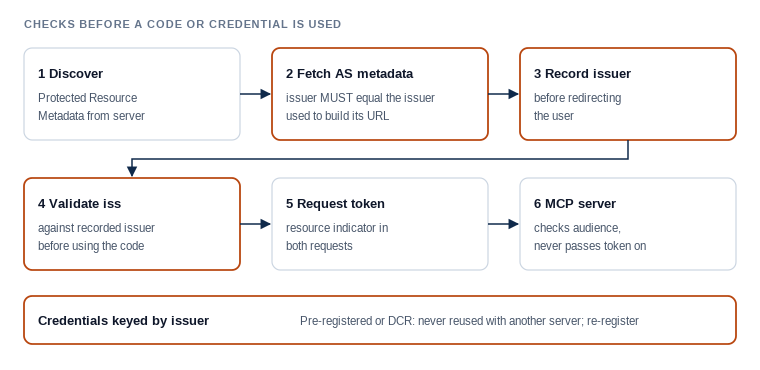
Source: Author's diagram, based on the MCP 2026-07-28 authorization specification. New requirements are marked in copper.
A stateless core changes where state lives
Removing sessions affects security design more than the changelog’s wording suggests. The previous transport used the Mcp-Session-Id header to tie requests together; the 2026-07-28 revision removes it, and the authorization text drops the phrase “even if they are part of the same logical session” from its rule that authorization accompanies every HTTP request. Any server that relied on the session identifier to carry authorization context needs another place for that context; I would carry it in the bearer token and in state the server can verify.
Where servers still need to carry state across a multi-step exchange, the new Multi Round-Trip Requests mechanism uses a requestState value that travels through the client. The specification is explicit about its trust level: “servers MUST treat requestState as an attacker-controlled input,” and if it “influences authorization, resource access, or business logic, servers MUST protect its integrity (e.g. HMAC or AEAD).” The specification allows integrity protection to be omitted “only when tampering can cause nothing worse than request failure.” For an enterprise server, I would sign or authenticate-encrypt every piece of state handed to a client regardless, and bind it to the authenticated principal, which the specification also recommends.
Two other changes in the same release close common gaps. Servers that process the request body “MUST reject requests where the values specified in the headers do not match the corresponding values in the request body,” which prevents a load balancer and a server from routing and executing on different values. And implementations “MUST NOT automatically dereference $ref values that resolve to a network URI” in schemas, which removes a server-side request forgery path. The existing rule that form-mode elicitation must not request passwords, API keys, access tokens or payment credentials stays in force.
Five updates for enterprise teams
For an organization running MCP servers or building MCP clients, I would turn the release into five tasks.
- Plan the move off Dynamic Client Registration. Inventory which clients register dynamically, confirm that the authorization server supports Client ID Metadata Documents, and set a date before the earliest removal, in the first revision released on or after 28 July 2027.
- Turn on issuer identification at the authorization server. Advertise
authorization_response_iss_parameter_supportedand sendissin every authorization response, including errors. The SHOULD is expected to become a MUST, and clients that see the flag must reject responses without it. - Test clients against a second authorization server. Confirm that credentials are keyed by issuer, that a changed authorization server triggers re-registration, and that a mismatched
issstops the flow. - Move authorization context out of sessions. Review servers that read
Mcp-Session-Id, and protect anyrequestStatewith integrity checks bound to the principal. - Recheck gateways. Where a gateway routes on the new
Mcp-MethodandMcp-Nameheaders, confirm that the server behind it rejects requests whose headers and body disagree.
The direction since November 2025 is consistent: registration based on published metadata, and clients that verify each authorization server they deal with. The project’s roadmap, published on 22 August, lists DPoP, workload identity federation and token exchange under its priority on agent identity and enterprise-ready security, which points to the next set of changes for enterprise deployments.