Agentic AI Security
Remote MCP Servers After the November 2025 Authorization Spec
Over HTTP, an MCP server should act as an OAuth resource server, and the 2025-11-25 specification says how. The flow step by step, what changed in this version, and the decisions it still leaves to the enterprise.
The simplest way to run a Model Context Protocol server is as a local process that reads an API key from an environment variable. That model breaks as soon as a server moves to a shared endpoint that many users and clients reach over HTTP, because a static key cannot say which user is calling, cannot be scoped per user, and cannot be revoked for one person without breaking everyone. The MCP specification has defined an authorization profile since its 2025-03-26 version, and its 2025-11-25 version, published on 25 November 2025, gives the most complete answer so far.
The specification is careful about scope. “Authorization is OPTIONAL for MCP implementations,” it says, but “Implementations using an HTTP-based transport SHOULD conform to this specification,” while those using the local STDIO transport “SHOULD NOT” and should “instead retrieve credentials from the environment.” For an enterprise, the practical reading is simple: any MCP server reachable over the network is an OAuth 2.1 resource server, and the specification describes exactly how it should behave.
The flow has eight steps, and each has a stated requirement
| Step | What the specification requires | Decision left to the enterprise |
|---|---|---|
| 1. Unauthenticated call | Servers “MUST implement one of the following discovery mechanisms”: the WWW-Authenticate header or a well-known URI | None |
| 2. Resource metadata | Servers “MUST implement OAuth 2.0 Protected Resource Metadata ([RFC9728])” | Which authorization servers the server trusts |
| 3. Authorization server discovery | Authorization servers MUST provide RFC 8414 or OpenID Connect Discovery; clients “MUST support both” | Whether the corporate identity provider plays this role |
| 4. Client registration | Priority: pre-registration, then Client ID Metadata Documents (SHOULD), then Dynamic Client Registration (MAY) | Which clients may register, and how |
| 5. Authorization | Clients “MUST use the S256 code challenge method when technically capable” | Consent and approval policy |
| 6. Token request | Clients “MUST implement Resource Indicators” (RFC 8707) in both requests | Token lifetime and refresh rotation |
| 7. Tool call | Servers “MUST validate that access tokens were issued specifically for them” | How the server reaches downstream systems |
| 8. Insufficient scope | Server SHOULD return 403 with insufficient_scope; clients acting for a user SHOULD attempt step-up | Scope design per tool |
Source: Model Context Protocol specification, version 2025-11-25, Authorization (requirement levels as stated in the specification). The right-hand column is the author's.
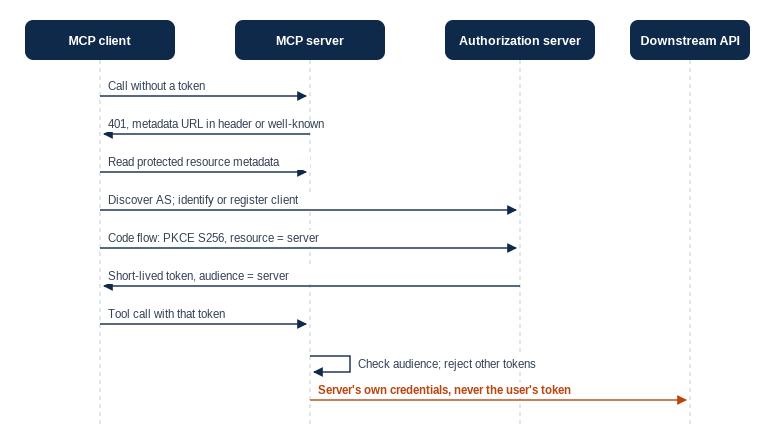
Source: Author's diagram of the authorization flow in the MCP specification, version 2025-11-25.
What the 2025-11-25 version changed
The previous version, dated 2025-06-18, had already made two requirements mandatory: servers must publish RFC 9728 protected resource metadata, and clients must send RFC 8707 resource indicators. The 2025-11-25 version makes four changes that matter for enterprise deployments.
- Client ID Metadata Documents. The version adds “support for OAuth Client ID Metadata Documents as a recommended client registration mechanism.” A client identifies itself with a URL that points to a document describing it, which the authorization server can fetch, so the client does not have to register dynamically with every server. The underlying IETF document was still an Internet-Draft at the time.
- Dynamic Client Registration becomes optional. DCR moves to MAY, and the specification states that it “is included for backwards compatibility with earlier versions of the MCP authorization spec.”
- Discovery is more forgiving. The
WWW-Authenticateheader becomes optional, with “fallback to.well-knownendpoint,” aligning the protocol with RFC 9728. - Scopes can grow during a session. The version adds “incremental scope consent via
WWW-Authenticate,” so a client can start with a narrow scope and ask for more when a tool needs it.
Two requirements carry most of the security value
Audience binding and the ban on token passthrough are the requirements I would check first in any MCP server an enterprise builds or buys.
The audience rule is direct: servers “MUST validate that access tokens were issued specifically for them as the intended audience,” and “MUST NOT accept or transit any other tokens.” Combined with the resource indicator that clients must send, this binds each token to one server. A compliant server rejects a token stolen from another MCP server, and a token issued for a general-purpose API.
The passthrough rule closes the other direction: “The MCP server MUST NOT pass through the token it received from the MCP client.” The specification lets a server act as an OAuth client toward upstream APIs, with a separate token issued by their own authorization server. My recommendation is to give that token the server’s own identity and the scope the server needs, so the downstream system sees the server as the caller. That keeps the user’s token from becoming a key to every system the server touches, and it gives each downstream system a distinct identity to authorize and audit.
The specification adds two hygiene rules that are easy to overlook: authorization servers “SHOULD issue short-lived access tokens to reduce the impact of leaked tokens,” and “For public clients, authorization servers MUST rotate refresh tokens.”
The decisions the specification leaves to the enterprise
The protocol defines the conversation between client, server and authorization server. It does not decide who runs the authorization server, which clients are acceptable or what each scope allows. Those are the enterprise’s decisions, and they are where I expect most of the remaining risk.
Which authorization server. Using the corporate identity provider, or an authorization server it federates with, keeps MCP access inside existing joiner, mover and leaver processes. A separate authorization server per MCP server multiplies the places where a departed employee’s access has to be removed.
Which clients may register. Client ID Metadata Documents and Dynamic Client Registration both let clients the organization has never seen obtain a client identity. That is convenient for public ecosystems. Inside an enterprise, I would restrict accepted client metadata URLs to an approved list, and leave dynamic registration off unless a specific client needs it.
What each scope allows. The step-up mechanism only helps if scopes map to meaningful groups of tools, such as read versus write, or one data domain versus another. With a single scope covering every tool, step-up authorization has nothing left to grant.
What runs locally. STDIO servers are outside this specification by design and take credentials from their environment. They need a different control: an inventory of which local servers developers may run, and managed configuration that limits them.
A remote MCP server that follows this profile is easier to govern than most internal APIs, because every call can carry an audience-bound token, short-lived wherever the authorization server follows the specification’s recommendation. The work for the enterprise is to make the surrounding decisions deliberately, before the first server goes into production.