Agentic Software Factory
Why AI Coding Stalls at the Pull Request
Coding agents accelerate one stage of delivery while review, release and rework absorb the extra work. Amdahl's Law, the review bottleneck, and the Level 3 operating model that lets the gain reach production.
Most large engineering organizations now pay for AI coding tools, and most report that developers write code faster. Far fewer can show that software reaches production sooner, or fails less once it is there. Coding is one of several stages between a ready ticket and a running change. The others, clarifying intent, review, release and repair, move at the pace of the people who own them, and agents send more work into exactly those stages.
I treat an agent rollout as an operating-model decision that happens to involve tooling. Bought as a license for individual developers and measured at the keyboard, it tends to produce more pull requests and much the same delivery speed.
Faster coding has a hard ceiling on delivery speed
Amdahl’s Law bounds the speedup of any system in which only part of the work gets faster. If coding accounts for a share p of lead time and becomes s times faster, the end-to-end improvement cannot exceed 1 / ((1 − p) + p / s).
| Coding share of lead time | Coding 2× faster | Coding infinitely fast |
|---|---|---|
| 20% | 1.11× | 1.25× |
| 30% | 1.18× | 1.43× |
| 40% | 1.25× | 1.67× |
| 50% | 1.33× | 2.00× |
Source: Amdahl's Law (Amdahl, AFIPS Spring Joint Computer Conference, 1967); author's calculation. Speedup of end-to-end lead time.
These ceilings assume every other stage stays the same size, and the evidence below suggests those stages grow. Adding a growth factor g for the serial stages (clarifying intent, review, integration, release and rework) makes the formula 1 / ((1 − p) × g + p / s), and gives a break-even point. With illustrative inputs of coding at 30% of lead time and coding twice as fast, break-even is g = (1 − 0.3 / 2) / (1 − 0.3) = 0.85 / 0.70 ≈ 1.21. A 21% growth in the serial stages erases the entire gain, and the smaller the coding share, the less growth it takes. The published figures below cannot be plugged in as g: review time measures one stage on the teams studied, and pull request size is not a duration.
The published evidence points to review as the stage that absorbs the gain
No single study settles how agents change enterprise delivery, and the most quoted ones come from vendors or small samples. I use each for the direction of the effect and none as a planning number.
Faros AI analyzed telemetry from more than 10,000 developers across 1,255 teams (July 2025). Teams with high AI adoption merged 98% more pull requests, while pull request review time rose 91% and average pull request size grew 154%. Faros “observed no significant correlation between AI adoption and improvements at the company level.” Each figure compares a team’s two highest-adoption quarters with its own two lowest, which holds the team constant but leaves no control group for whatever else changed, and Faros sells engineering analytics.
CodeRabbit compared 470 open-source pull requests (December 2025) and found AI co-authored changes carried about 1.7 times as many review findings as human-only ones. Authorship was inferred from signals in each pull request, the findings are review comments, which may or may not prove to be defects, and CodeRabbit sells AI code review. The counts are per pull request, so they cannot separate the effect of larger changes from an effect on quality, and the sample is open-source work an enterprise codebase may not resemble. Even with those limits, the extra findings land on a reviewer who already receives larger changes.
DORA’s 2025 report on AI-assisted software development describes AI’s primary role as “an amplifier, magnifying an organization’s existing strengths and weaknesses.” Read together, these sources describe one mechanism: output rises where the agent works, and the review stage absorbs larger changes with more findings per change.
Ungoverned agents accumulate three kinds of debt
Beyond the queue, ungoverned agent output also leaves debt behind, and each kind has its own signal and its own control.
| Debt | What it is | Early signal | Control |
|---|---|---|---|
| Technical | Code that works but is hard to change | Churn and rework rate | Deterministic hooks; independent verification |
| Intent | Behavior nobody wrote down or approved | Clarification loops; changes that cite no specification | Durable specifications and a Spec Gate; scoped context |
| Cognitive | Code no current engineer understands | Fast approvals of large changes | Merge Gate on evidence; a critic that did not write the change; reviewer skills |
Source: Author's framework, The Enterprise Agentic Software Factory.
Agents build up all three faster than a human team, because they produce more change per hour and cannot follow a rule nobody gave them. A rounding rule that lives only in one engineer’s memory can be neither followed by an agent nor checked by a reviewer, and it surfaces in production as a rework deployment.
Level 3 autonomy is the default I recommend for most enterprises
A five-level scale makes explicit who decides what at each stage of agent adoption. It is a framework from my book; Claude Code, for one, has no such setting.
| Level | Agent scope | Human role |
|---|---|---|
| L1 Assisted | Suggestions and chat | Writes every change |
| L2 Supervised | Edits within one session and one task | Approves each step |
| L3 Conditional | Ticket to pull request, inside shared rules and gates | Change Owner approves the specification and the merge |
| L4 High | Merges low-risk classes of change | Audits samples after the fact |
| L5 Full | Plans and ships without approval | Sets objectives only |
Source: Author's autonomy scale, The Enterprise Agentic Software Factory.
Organizations that adopted agents one developer at a time usually sit at Levels 1 and 2, without shared rules. I recommend Level 3 as the enterprise default and as the ceiling for regulated production. My argument is accountability. As I read the change-management obligations regulated organizations work under, each production change needs a named approver, and an agent cannot hold that role. A standard change earns its pre-authorization by being predictable, with fixed steps and a known risk. An agent generates the steps for each change, so I keep the approval per change in regulated production until a class of change has a track record that auditors accept.
Two human decisions replace line-by-line review
At Level 3, a named Change Owner for each domain makes two decisions, and machines do the checking in between.
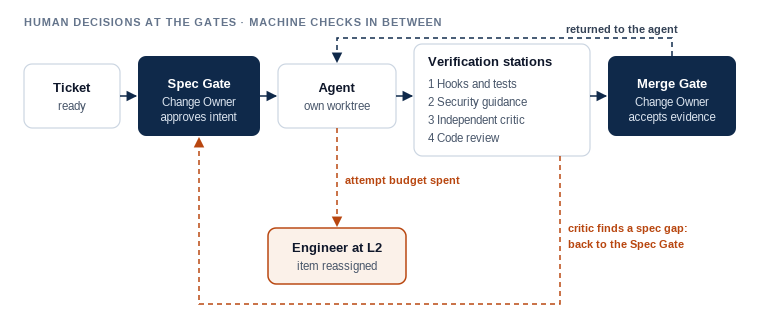
Source: Author's diagram of the Level 3 flow in The Enterprise Agentic Software Factory.
The first decision is the Spec Gate. Before any agent starts, the Change Owner approves the change to the domain specification that the ticket implies, so ambiguity is resolved by a person while it is still cheap.
The second is the Merge Gate. The Change Owner accepts or returns the change on an evidence bundle: the approved specification change, the required test results, the verdict of an independent critic, and the resolution of every review finding. The diff is read line by line when a stated trigger applies: a path that moves money, writes ledger postings or touches authentication, a migration, a critic verdict that needed more than one round, a diff that is large relative to its specification change, or a pull request flagged for a security scan. A change flagged as high risk also waits for a security champion’s interactive scan, the one other human wait in the flow. Outside those triggers, the reading follows the findings. The trade-off is explicit: an error that every station missed and no trigger covers can reach production, which is why a Change Owner from another domain re-reads a random sample of accepted changes each quarter.
The business case is measured per service, against itself
Before funding, I rebuild one quarter of delivery metrics for each candidate service from records the Git host and pipeline already keep. DORA’s change lead time starts at the commit, but intent is clarified before it, so I measure from a ticket marked ready to the change running in production and split that window into stages: clarify intent, code, review wait, review and integration, release wait, and rework. That baseline shows which stage is largest, and therefore how much faster coding can help at all.
After rollout, two measures decide whether a service keeps its autonomy: lead time and deployment rework rate. A third, agent cost per merged change, shows what the improvement costs. Self-reported time savings and lines of code stay off the scorecard. In METR’s 2025 randomized trial, 16 experienced open-source developers took 19% longer with AI tools while believing afterward that they had been 20% faster. METR has since marked those results as out of date; its February 2026 update reports some evidence of speedup and calls its new data an unreliable signal. The gap between felt and measured speed in the 2025 trial is still the error a program funded on perceived savings inherits.
Four steps fit in the first month
- Rebuild a quarter of delivery metrics for two candidate pilot services, with lead time broken down by stage.
- Name a Change Owner and a deputy for each.
- List the “never” rules that exist only in prose or in people’s heads, and decide which become specification cases.
- Find out how quickly you can move one service, and then every developer machine, from Level 3 back to Level 2.
The rest of this series covers each part of the model: durable intent, the agent workbench, independent verification, headless pipelines, and the telemetry that shows whether the investment is paying back.